
Image
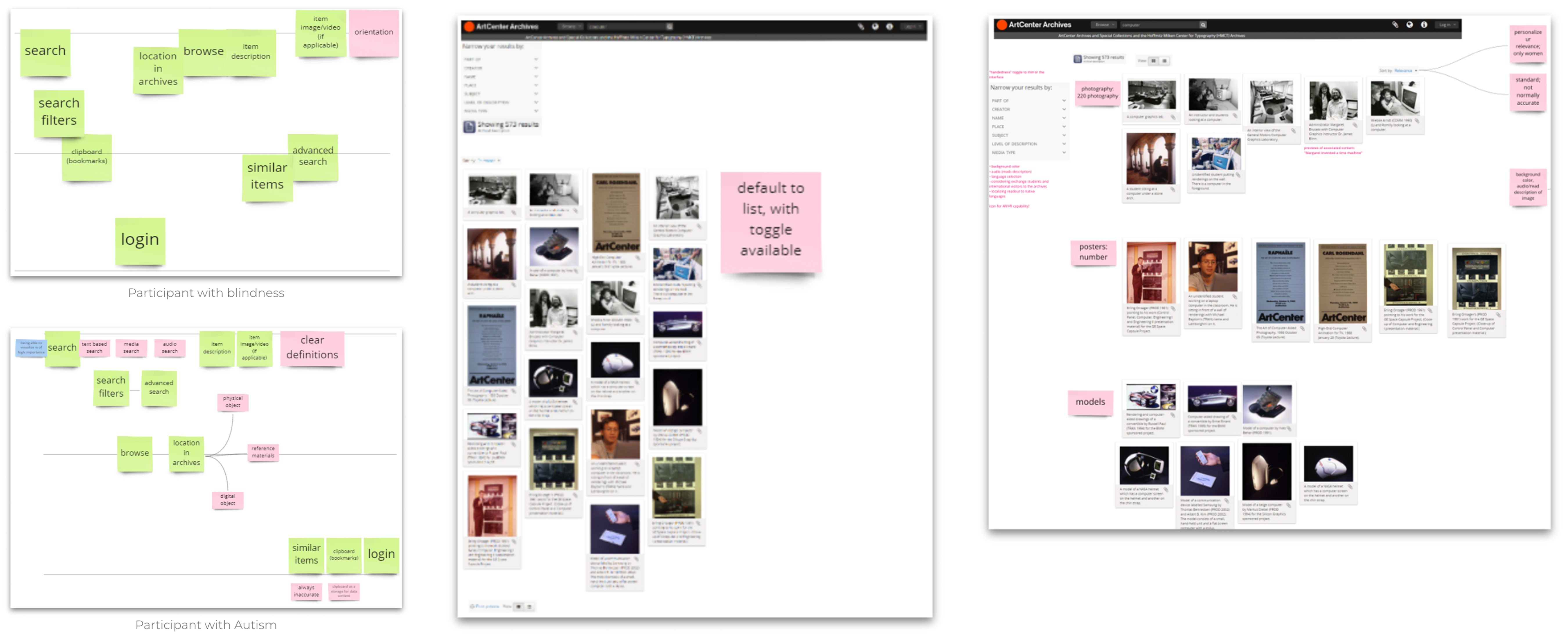
Participatory Session Interview Card Sort The card sort was conducted on a Miro board. One of our participants was blind, so we read each card aloud and had them rank them high to low, followed by added rounds of refinement until they were satisfied with the result. Any added insights in the discussion were recorded. Another participant with autism spectrum disorder placed great emphasis on the granular details of descriptions and sub-categorizations within the items listed. Re-Arrange Exercise The “rearrange” exercises proved valuable in discovering the best ways to layout the interface, both for a user of assistive technology and another who prioritizes visual input and organization. When conducting the exercise with a user who depends on a screen reader to navigate the content, we discovered that the visual layout was not as relevant as they had no indication of items left to right of one another, while another sighted participant placed emphasis on the management of content and providing spatial separation.
Image
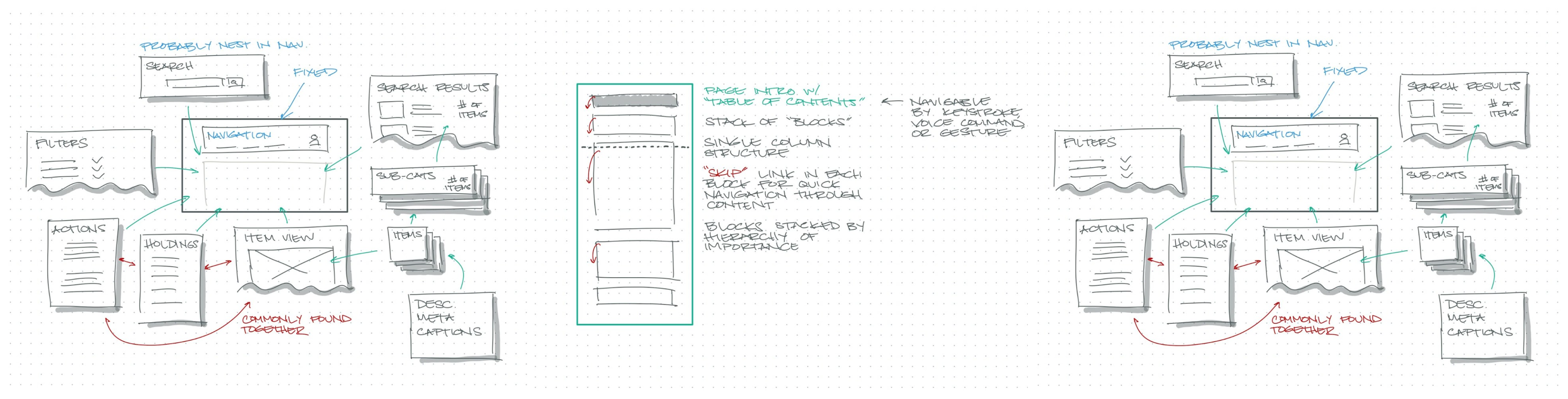
Design Concepts Modular 'Block' System A modular approach to building the interface, where the blocks are indexed in a “table of contents” so to speak, for each page that is introduced to visitors before engaging the information within them. This “block” system will also nest “sub-blocks” for improving navigation. Single Column Arrangement In our interface “rearrange” exercise, one of the resulting interfaces was a stack of components in a single column. This is a design system typically familiar to mobile devices, but can be easily leveraged for a responsive desktop viewport. Within the column, the blocks could be scrolled through, or skipped through using hidden links that will be read by assistive technologies. Predefined Categories with Content Dependency Insights from our participatory interviews suggest that information systems that provide an introductory base categorization make for easier navigation and discovery of desired content. Much like digital streaming platforms that incorporate pre-categorization, like Netflix for instance, we propose having results broken down with the ability to further filter down their results, along with user-specific/user-generated content categories. Improved supporting information such as alt-text, metadata, captions, transcripts, and descriptions would further reinforce the functionality of this system.